When traveling from the Kansai region to Awaji Island or Shikoku, many people think about taking a highway bus from Sannomiya or Osaka.
However, the optimal solution recommended by professional travelers and public transportation consultants is actually a route via “Maiko” in Tarumi Ward, Kobe City, Hyogo Prefecture.
Why is Maiko so important? How can you transfer without getting lost? This article provides a thorough explanation of how to navigate this “terminal in the sky” based on the latest data as of 2026.
Why Are Maiko Station and Kosoku-Maiko Bus Stop Important?
There are two main reasons why Maiko is called a strategic gateway.
Complete Avoidance of Traffic Congestion
If you take an express bus from Osaka or Sannomiya, you must pass through the chronically congested “Hanshin Expressway Route 3 Kobe Line.” During holiday periods, delays of over an hour are not uncommon.
On the other hand, if you go via Maiko, you can bypass the congested section using the punctual JR Kobe Line and board the bus just before the Akashi Kaikyo Bridge. This significantly improves the reliability of your travel time.
Overwhelming Number of Routes and Excellent Connections
Kosoku-Maiko Bus Stop is a “hub” where almost all buses crossing the Akashi Kaikyo Bridge stop.
- Awaji Island direction: To all areas of the island including Iwaya, Sumoto, and Fukura.
- Shikoku direction: To major cities like Tokushima, Takamatsu, Matsuyama, and Kochi.
The “vertical intermodal connection” that vertically links the train station (2F) and the highway bus stop (5F) enables smooth transfers.
2. Important Points When Transferring at Maiko
There are several points where first-time visitors are most likely to make mistakes.
- No staffed counter or ticket machines: There are absolutely no places to buy tickets at the bus stop (4F/5F). For long-distance buses to Shikoku, you need to complete web reservations or convenience store payment in advance. Buses to Awaji Island typically use pay-on-exit (IC cards accepted), but some companies don’t offer in-vehicle charging, so charge your card at the JR station beforehand.
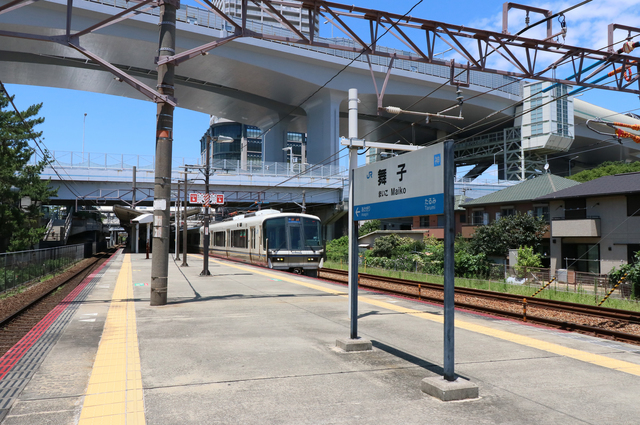
- “Special Rapid” JR trains don’t stop: Only “Rapid” and “Local” trains stop at JR Maiko Station. If you take a “Special Rapid” from Osaka, you’ll need to transfer at Sannomiya or Kobe Station.
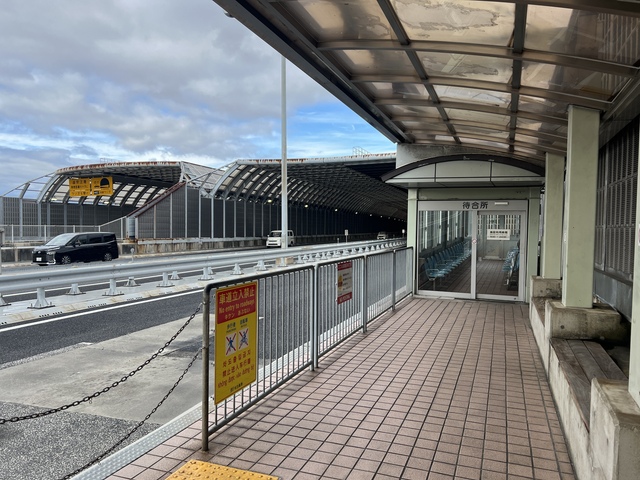
- No toilet on the 5th floor (platform): Restrooms are only located on the “4th floor waiting room” one level down. Make sure to use them on the 4th floor before your bus arrives.
- Upbound (Honshu direction) is “alighting only”: You cannot board express buses bound for Sannomiya or Osaka from Kosoku-Maiko. Remember the rule that on the return trip, you alight from the bus and transfer to the train.
3. Transfer Method (JR Maiko Station → Kosoku-Maiko): From 2F to 5F
Kosoku-Maiko has a multi-level structure. Simply put, you go up in this order:
Station (ground level) → Entrance → Intermediate floor → Platform
1) Turn right after exiting JR Maiko Station
- There’s basically one ticket gate. After exiting, follow the signs toward the Akashi Kaikyo Bridge (Maiko Park direction).
2) Follow the yellow signs
- The route splits partway.
- Go up by escalator (if traveling light / when weather is calm)
- Go up by elevator (with large luggage / stroller / on windy days)
3) Do a final check at the concourse level
- Three things to do here:
- Use the restroom (there isn’t one on the platform level)
- Check the electronic board for your bus and platform number (1 or 2)
- Get drinks, etc. (note that the shop may be closed during certain hours)
4) Finally, go to the platform level
- There are mainly 2 platforms:
- Platform 1: Shikoku direction (Tokushima, Takamatsu, Kochi, Matsuyama, etc.) + some Awaji Island buses
- Platform 2: Mainly Awaji Island direction
4. The “12-Minute Rule” for Mastering Maiko
Allow 12-20 minutes for transfers
The minimum travel time from the station to the bus stop is about 5 minutes, but considering elevator wait times, restroom breaks, and unfamiliar navigation, having 20 minutes from station arrival to bus departure is safe. This is called the 12-minute rule (minimum 12 minutes required).
Ride in the east end (Sannomiya/Osaka side) on JR trains
Maiko Station’s platform is very long, so riding in a car close to the ticket gate is essential.
- When coming from Osaka/Sannomiya: Front of the train (east side)
- When coming from Himeji/Akashi: Rear of the train (east side)
This alone can save you 1-2 minutes of walking time.
Use as a traffic jam anchor on the return trip
When returning from Shikoku, if the Hanshin Expressway is congested, don’t hesitate to alight at Kosoku-Maiko and transfer to JR. You’ll arrive faster by taking the train than sitting in a stopped bus.
Detailed Access Analysis from Major Cities to Maiko
| Departure | Route | Travel Time (approx.) | Fare (approx.) | Notes |
| Osaka (Umeda) | JR Kobe Line (Rapid) | About 50 min | 840 yen | Note: Special Rapid doesn’t stop |
| Sannomiya | JR Kobe Line | About 25 min | 320 yen | Sanyo Railway (Maiko-koen Station) also available |
| Himeji | JR (Special Rapid→Transfer at Akashi)) | About 40 min | 680 yen | Cross-platform transfer at Akashi is convenient |
From Osaka
Take a Rapid train from Osaka Station for direct service. If you’re in a hurry, you can take the Special Rapid to Akashi, then take a Local train back one station.
From Sannomiya
JR is the fastest and cheapest. If JR services are suspended due to an accident, use the Sanyo Railway “Direct Limited Express” to Maiko-koen Station.
From Himeji
From Himeji, the smoothest option is to take the Special Rapid to Akashi Station, then transfer to the Local/Rapid train waiting on the opposite platform.
Summary
Kosoku-Maiko Bus Stop is not just a transit point, but a strategic device that maximizes travel efficiency.
If you allow a 20-minute margin, prepare tickets in advance, and use rapid trains, your trip to Awaji Island and Shikoku should go smoothly.
Enjoy a well though out journey while admiring the spectacular views of the Akashi Strait Bridge!